Michael Werner: How did the Liberty in Business Group come about?
David Wertheim-Aymes: As a businessman one of the most important concepts that became a reality in my own thinking out of the influence of Rudolf Steiner’s books and lectures, where he distils out the Threefold Societal Order, is that ‘Business is not Nature’. In the Natural world are minerals, plants and animals; and then there is the Human Being gifted with human capacities. Businesses do not appear in the natural world. Businesses only appear where human individuals gather. Therefore, businesses are founded out of a modern human capacity that is not present in animals. Anthroposophy places its emphasis on identifying, understanding and developing this Humanity in us. Many people, and some Anthroposophists, blame just business people and governments for the World’s social and environmental problems today. This is a patently false and misguided view. The failure is from the lack of true inner self-awareness in society in general and in our education and religious systems. Our education and religious systems have not been able to build a relationship or link between individuals and their own higher nature and the world around them.
As an Anthroposophist, when one discovers these realities and that they worked practically in one’s own challenging economic environment then one wants to give back to others.
Andrea Valdinoci, director at the World Goetheanum Association (WGA), was one of the few people that heard this reality in his heart and was warmed by it. He recognised the potential that this could unleash in businesses if correctly understood. Andrea also saw inwardly how this could add value to the economic organisations already connected to the WGA. Andrea and I were aware of a few other people in the world who were working carefully in the spiritual conceptual world of the individual and the reality of the problems being faced in the world today. From this the LiB core group formed and meet twice a month. (They are Andrea Valdinoci (Switzerland), Louisa Barnum (USA), Omri Elad (Israel), Sarit Jacob (Israel), Michael Werner (Germany) and Chandré Wertheim Aymes (South Africa).)
MW: How would you describe the task of the LiB Group, what is central to it for you?
DWA: The task of the LiB (Liberty in Business) Group is to try to distil out of the general noise of modern business the exact ‘location’, presence and influence of the human being in this activity of doing business. If one can do this, one can then possibly learn to develop it, focus it, encourage it, and so on. If one cannot identify quite specifically the existence and reality of the human being in all economic activities, then one cannot work with it. The LiB Group is striving to understand this issue and grasp it consciously so that it can be shared and used by others.
MW: Why is it so important now for the future of businesses to become aware of human capacity and unfold this potential?
DWA: We live in the reality of an evolving human consciousness. This is often not easy to see and work with. Today we are at a stage of evolution where we have fully developed the capacity to reason and operate with the logic of the material world around us. This historically developed capacity of the human soul has been at the foundation of what our economy and societal structure is today. One could say that economic activities up until today has been more and more dynamic because of the massive increase of needs for material things and we have the capacity to fulfil these needs with the abundance of nature wherein we live. However, while this was all happening under the capacity of intellectual reasoning, the human soul was becoming disconnected from itself as a spiritual reality and force. The religious movements and the education systems became servants to this intellectual and materialistic capacity. The real inner human lost itself and that’s where we are today and what we have to look in the face and deal with.
Business, and other areas of life, is no longer as easy as it was. Businesses need the people in their teams to be more self-aware of their human capacity and practise developing a more coherent and balanced inner soul life than in the past. This must reach to as many staff as possible. Today businesses are battling with souls that are not inherently prepared to deal with these inner questions and do not know instinctively where inner soul health comes from. The education and religious movements are not really able to help. Societies are hanging onto the status quo because they cannot see the next steps forward. Anthroposophy offers some of these quite clearly if one is willing to be dedicated to spiritual scientific concepts.
MW: What do you mean by this?
DWA: Business has flourished despite ignoring the requirement for the conscious moral involvement of people. This has led us to where we are with all the social inequality, enormous waste and damage in nature, society and people. If we want a new societal structure based on spiritual ideas, then we need to learn how to engage ourselves differently. We need to work out the difference between using the content of textbooks versus the content of the ‘All knowing’. I will address some of the detail here in further questions I am sure.
MW: Let’s put the focus on Bosun and what you implement there: What does this awareness work look like at Bosun?
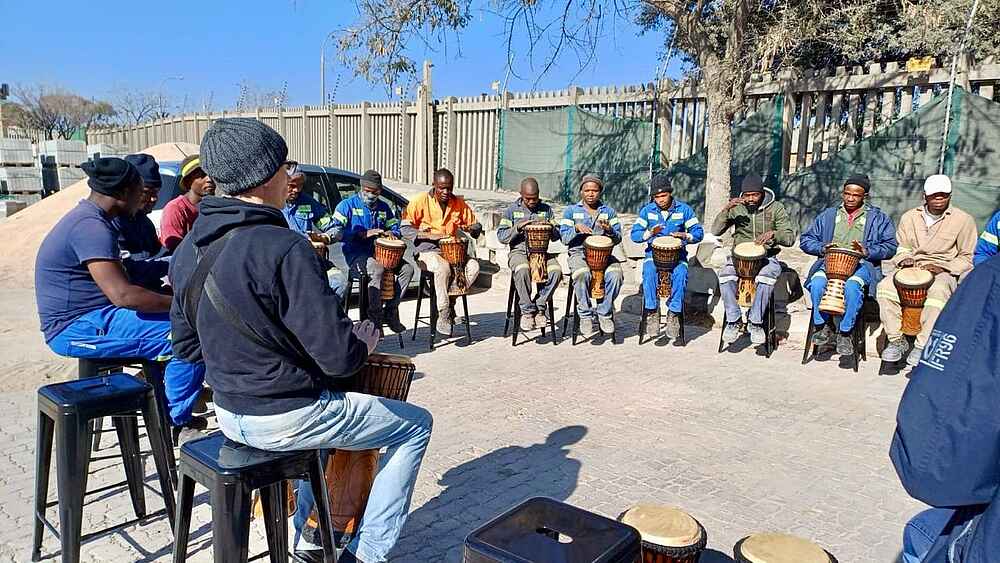
DWA: At Bosun we understand that all economic activity comes about amongst human beings as I have said above. This means that where there is only nature, there is no economic activity. When economy comes about, one must conclude that it has something to do with the significance of the human soul and the ‘I’. And different times need different economies, and we need to change our economy now. We therefore work to assist our people to become self-aware, aware of their world, their soul and I competence. Every week, we put time aside during office hours for people to freely work with the conceptual building blocks of spiritual science. We use the body-soul-spirit concept to assist people to understand themselves and their interface with the world and with others in business. We can see that this awakens and deepens the connection of their souls to the reality of their humanity. Thinking becomes a force when it is consciously connected to bigger pictures and truths like body-soul-spirit. They experience how their thinking is changing and they incorporate this new reality in their lives and this can be experienced by them when they see the resultant changes in their environment. From this point on they become engaged in wanting to know what they are allowing to live in them. We say that “what lives in us appears around us”. This is one of the central `Thoughts seeds’ we use in daily practise at Bosun.
We use many small steps to get here. Examples of these steps are how we look for staff, how we induct them, how we do reviews with them, what their staff files look like, how we run meetings, how we measure things and more. We have all sorts of imaginations and games that we use to assist core concepts to be palatable, yet implicitly correct to colleagues. We support people so that they can resurrect these insights out of their own ‘I’ forces more easily in the future. This empowers their inner lives and they become able to use more or less of these imaginations depending on their individual engagement.
At Bosun we are using phenomenology in every meeting. We look at the issues, find the essence, and allow our inner lives to search for a better logic than we are able to find with our intellect alone. Bosun would simply not exist if it were not investing in the ‘human’ element in its people. We can clearly see here that all human-made things must be seeded from thoughts and then taken care of by repeatedly and earnestly reconnecting to these. Our central question is, ‘What seeds our business?’ and we believe, that our People are the seeds of our businesses. So, it is essential to find out how this seeding works!
MW: Your management structure is three-folded and includes a Head of Liberty; what is his role?
DWA: We have three departments lead by different people: “economy-sphere”, which contains sales and production, “equality-sphere” (finances, numbers and rights) and liberty. The Head of Liberty has the role of bringing consciousness to the organisation. This person sits in on all the different threefold meetings and watches for shortfalls in Liberty competence and devises ways to try to empower people through growth and capacity of their own self-awareness. They offer training, personal development plans, different ways of reporting that would get deeper into people and so on. They work with problems around people, inductions and finding better ways to communicate in meetings.
The head of Liberty has the central task of holding the consciousness that the human being is the nourisher and rejuvenator of the entire threefold societal organism, just as the digestive system is in our physical condition.
MW: What does "economy" mean to you, and how do you implement it in your company?
DWA: Economy is defined as “Providing for the material needs of others.” We have added two words to this and say, “Providing relevant products for the material needs of others efficiently.” These words just sharpen the definition a bit and make it easier to work with. We have discovered this definition is an enormous spiritual power in itself. When we look at a physical circle, we can see whether it is obeying this concept of circle, or not. When it does so, one can feel a sympathy and if not one can feel an antipathy response. If one considers the definition of economy in the same light, we can see that we have to be producing something RELEVANT for the MATERIAL needs of OTHERS EFFICIENTLY. When I think of my earlier years, I did not take on a job to support this particular spiritual force. I took it on for my needs. I was never told that by taking on this job, I was committing to this ‘being’ of economy. I was not aware that I had to support this being by doing everything I could to provide relevant products for the material needs of others efficiently. Now that I have become aware of these facts, I feel so much more empowered because I can clearly see what I should be supporting. (One can easily sense now that a good business is one that supports this being of economy.) And, just for the doubters and sceptics, the definition implicitly steers one away from self-indulgence, greed, falsity and harm to nature and others. At Bosun we are making people aware of this from the very beginning of their joining our particular economic activity. Over the years people get a bigger perspective and can align to it from a real truthful perspective, a spiritual scientific idea. This nourishes their inner life to connect to something more than just a job, and from this they become much more powerful and influential in their role and contribution on the value chain; and of course they take this all home with them also. They feel their inner ‘seeding power’ as a reality and that’s what we need for changing business practises today.
MW: What approach have you developed in production and sales, and how do these two areas connect?
DWA: Our management structure is set up to ‘discover’ what the market perceives as relevant – from the definition of economy. This means that we have to be really good listeners, not good story tellers. This is a pivotal difference. We stay away from aggressive selling techniques. We try to meet the objective of the customers – what do they need! And we know that: They make the choice. We are content with this orientation.
We also to try to excel at being efficient in production and distribution. Efficient means no waste of any kind, no damage, no excess and, best layout from a flow perspective, best methods, machine people balance, and so on. This drives costs down without having to compete with others. The better the human capacity in both relevance and efficiency, the better becomes the relevance and efficiency in practical and business terms. (Relevance is the Income side of the Income Statement while Efficiency is the cost side.) The Equality sphere (finances, numbers, contracts) makes sure that everything is connected and coherent and that it feeds back objectively what is actually happening in sales and production.
MW: What do you look for when you take on new people at Bosun, and what is the process?
DWA: In essence we look for people who have soul qualities of interest, reverence and courage. Skills and experience are next. One can always teach sound human souls, Waldorf graduates for example, skills. Experience they can also get over time. But: When a soul has no interest, reverence or courage, one is taking on a very big task.
We word our advertisements to attract such people. We ask questions at the interviews that could shed light on these qualities. We give the candidates a chance to ask questions themselves and always prompt them for more. This entire process assists us to establish what lives inside them. We then try to connect what they have inside them to what is specifically required by their business role. The better the alignment, the better the chance of mutual value for them and the business.
I could go on a lot here, but in brief, we do a liberty Handshake agreement which is an agreement outside of the legal sphere where we promise each other from the heart what we freely wish to. This is followed up by a careful induction in great detail and we are patient in this. In the long run we do reviews with them twice a year where the review looks at who they were versus who they are and the inner development that has taken place over the past six months. What I say is all very abbreviated, but we are willing to share more details with anyone interested.
MW: You are currently in the process of transferring the company into responsible ownership; how do you use surpluses today?
DWA: We have only over the last 5 years got into a position of surpluses. Economic activities require a long time to become a representation of what lives as the idea initially. This process can take decades. It is only when the idea and the outward manifestation are closely aligned and in harmony with the essence of economy itself that surplus arises sustainably. We are also in a process of handing over the business to a younger generation. They need a challenge, more than what we are currently doing. For this reason, we/they will use the surpluses for the next 5 years at least to fund several expansion plans that we have conceived together. In any event we are using quite a bit of the current ‘surpluses’ to fund the training and development of our staff today as this builds a sustainable future seeded by healthy human beings. We are building up our Liberty capacities and will see how this manifests in what we are able to be in future.
MW: A central aspect of being human is the ability to continually reconnect with one's own inner source. How do you do that, and what questions are you currently working on?
DWA: What nourishes me is my own deeper understanding of myself and the world as I learn to live. We should be able to say of those that die “They knew how to live!” I want to be such a person. This perspective nurtures me, but it is a challenge. Spiritual Science on its way to becoming Anthroposophy, along with the Christ in me, are for me the guides to this path as to knowing how to live. These we must be able to find these in the detailed aspects of life; even to where they are when one washes dishes.
I am currently busy working on refining my own insights into how one can link the inherent capacity of materialistic thinking, that is present in all modern souls, to carry us over the ‘abyss’ of disbelief and scepticism about the world of ideas and spirit and into the world of deeper consciousness as a soul capacity. There is implicit logic in the material sciences. If one takes this implicit logic and adds a few of the core spiritual scientific concepts to this way of thinking, then a few steps are added to our perspective on life. An example would be that if one is wanting to build a new factory or house with only material thinking, then costs and size and materials and form are completely determinant of the structure that will appear. A different result is possible if one holds in ones thinking the essential nature of the mineral kingdom being that the bricks and mortar will stay in the form conceived as well and as long as our thinking has given it a chance to do this. This allows for new ideas around the structure to assume a much more holistic end result. Such a shift has a big effect in changing our relationship to the end form. We need to be able to find an accessible way, within ordinary living, to gain access to the consciousness soul while developing it. This is what I am enjoying exploring.
Thank you, David.
Thank you, Michael.