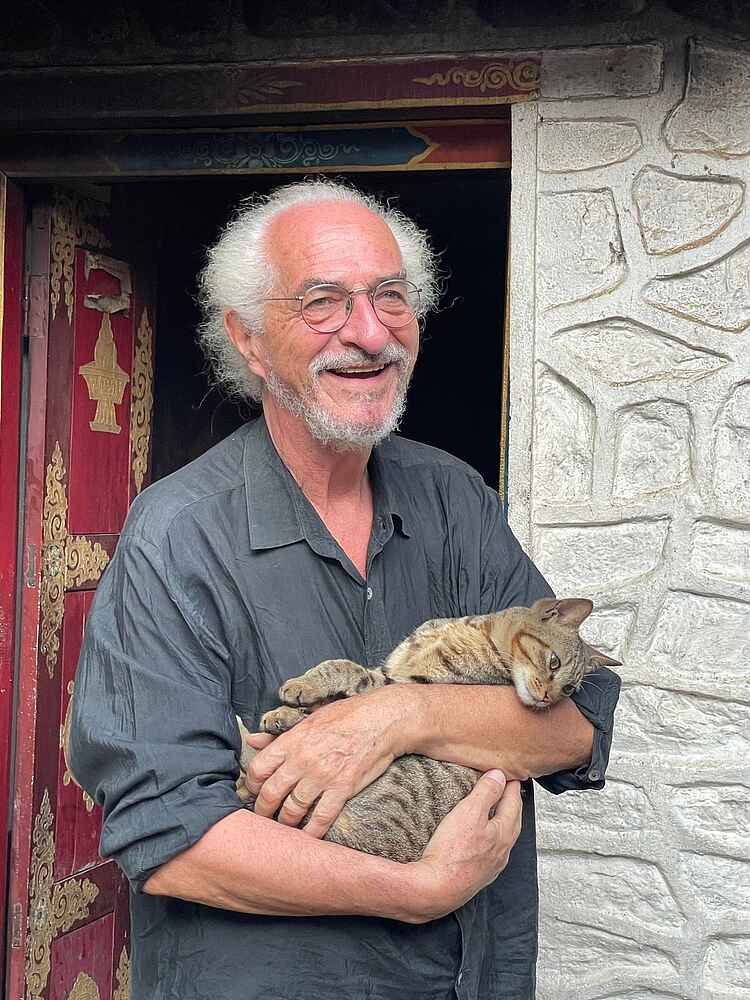
AV: Could you take us on a tour of this learning space that you’ve been developing for around 16 years now?
WSH: Yes, it is indeed a learning space, but one that also extends across parts of Asia – through our physical presence, projects and ongoing communication, as well as through lectures and training courses delivered online. I was originally invited to the Philippines for a few lectures and stayed here after meeting Grace; together we decided to make our skills and what we stand for available here.
At our actual place of learning, the opportunities for participation are limitless. I see anthroposophy as a cultural renewal – there is actually nothing where we cannot achieve something meaningful through expansion based on anthroposophy. In doing so, it is important for us not just to preach, but to be able to demonstrate something practical. This begins with agriculture: we bring biodiversity to life, we make the preparations, we grow seeds – all on a small scale, but we are pioneers for more extensive undertakings. We are involved in education and health issues. There are plenty of simple ways to support people in their development and in their needs – from financial matters and the enforcement of rights to wastewater treatment and so on. Beyond our own country, I am currently supporting initiatives and people in China, Nepal, Bhutan and India.
AV: What has been your experience with the World Goetheanum Association Asia? What is working well, and what can we learn to help us continue to develop this effectively?
WSH: As far as I understand, one of the key aspects of the WGA is that we have roughly as many anthroposophically inspired businesses as we do members in the Society. That represents enormous potential. An important aspect here is ‘preaching to the choir’: how many Waldorf teachers or parents actually know about anthroposophy and all the things that can be done with it?
Let’s take dm as an example – they have a large catalogue of further training courses. This has been carefully built up; it is a huge cultural achievement. When we talk about 50,000 businesses and institutions worldwide, there are probably fewer than 50 in Asia (apart from biodynamics and Waldorf). So we are very much at the beginning in Asia. Even in the biodynamic and Waldorf sectors!
Added to this is the fact that existing businesses here also lack depth of understanding. Last year, for example, we ran a training course at a large biodynamic farm in India. The owners felt that, although they were applying the preparations, their staff didn’t really grasp how all this relates to the cosmos or to personal development. And indeed, our contribution seemed to be something they had been longing for – until then, biodynamics had been carried out almost mechanically; now it was brought to life through sensory experiences.
In Asia, there is also a significant linguistic divide: China and the rest. Those open to anthroposophy usually speak English – but this is generally not the case in China, so we need translations. This also justified our decision to charge a fee, which wasn’t a bad thing at all: the Chinese are absolutely used to paying for such services. That would be something for the future – charging fees for participants from Asia, and also offering some of the Goetheanum’s programmes as part of a basic education in anthroposophy. Because that is what we need; Europe is a hundred years ahead of us in this respect: general education, public education in anthroposophy.
As I travel a lot anyway, I have also represented the WGA face-to-face wherever I happened to be working. This also gave rise to the leadership workshops: following an enquiry in the summer of 2024, I ran three modules for Chinese participants – I had intended to hold the fourth abroad, but we ended up doing it here in Palawan. Due to the party’s strong nationalist propaganda, the Chinese are not very accustomed to thinking in terms of global interests – which is why this overseas module was important.
The leadership programme has generated significant entrepreneurial momentum: two participants from key organisations have established new initiatives to promote organic farming in Asia. A very large organic farm is expected to switch to biodynamic farming. A workshop like this is about the personal experiences we share – and these lead to such developments and, in turn, to growing networks.
I am convinced that we cannot do without online formats, but we must do as much as possible through genuine human interaction. The Goetheanum clearly sees it the same way, when I think of the agricultural conference.
AV: My impression of your work is that you always approach these topics through the practical, through what people can experience for themselves – not by lecturing, but through lived experience. How has the associative played a role in your career?
WSH: My teaching method is based on the conviction that we face a major challenge today: the virtual world. We must learn to distinguish between the sensory and spiritual world on the one hand, and the virtual world on the other. This is more advanced than most people realise.
When I ask, “What have you actually experienced yourself?”, most people reply with things they’ve heard on the news. It is only after I have asked three times that it dawns on them that I am asking what they have perceived with their own eyes and ears. The senses are a foundation of self-empowerment.
That is why I focus on the very simple things: the senses, the processes of life, the supplementary exercises. From there, the path to the associative is not far – for then it leads to encounter. And everything associative is based on encounter.
The associative pops up everywhere: it starts as soon as I’m paying at the till and ask, ‘Can I afford this?’, or when someone asks, ‘Can you give a talk? How much does it cost?’ I always try to get the person I’m talking to moving – not just to name a price, but to ask: What is possible for you? How much is it worth to you? Do you know anything about me and my needs?
Here, however, these things are still in their infancy. When we produce seeds or preparations here, we’re just glad if anyone wants them at all – because people have no idea what biodynamic seeds actually mean, or what it entails to have spent years breeding them. This question of value and price – we’re still right at the beginning of that journey. People are truly amazed when you explain it to them.
AV: Thank you very much for this collaboration – for the attempt to bring together and strengthen the existing forces and to see what is needed. Thank you for these five years. It won’t be easy to find a successor for you. I hope we’ll stay in touch. And many thanks – also from all my colleagues – that, despite the great distances, we’ve managed to build the World Goetheanum Association a little further together. Warm regards also to your wife Grace.
WSH: Many thanks from me too. It has been a wonderful experience to be able to work together like this – to see what we can achieve. We will, of course, continue to work on these matters, and I hope that someone with the right background will come forward.
Andrea Valdinoci: At the moment, we at WGA Asia are trying to form a group of young people from different countries who are interested in and committed to the transformation of the economy, and who can then continue to support the core of the WGA’s work.